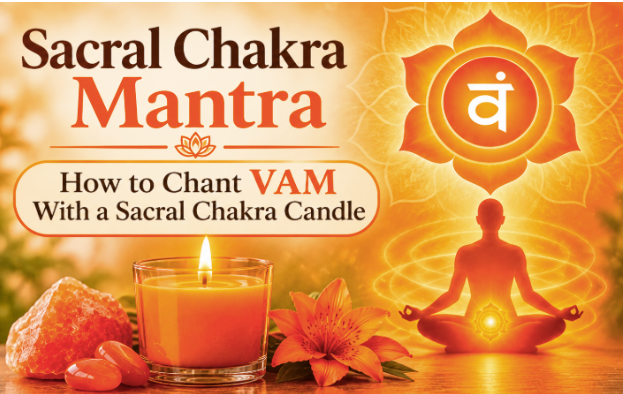
The sacral chakra mantra is VAM, a traditional seed sound associated with Svadhisthana, the second chakra in the seven-chakra system. Positioned in the lower abdominal region, the sacral chakra is traditionally connected with creativity, emotional expression, pleasure, and the element of water. Chanting VAM during meditation can provide a simple way to focus your attention on these themes.
VAM is a one-syllable sound (a bija mantra or ‘seed mantra’). It’s traditionally used as a point of focus in chakra meditation, with the focus being on the qualities of the sacral chakra.
You can make this practice much more personal by putting a sacral chakra candle in your meditation space. The candlelight gives you a visual anchor and chanting and focused breathing will, of course, create the space for you to actually meditate.
Whether you’re new to chakra meditation or you’ve already got a spiritual practice in place, having an understanding of the VAM mantra will help you go about the practice with greater intention.
What Is the Sacral Chakra Mantra?
The sacral chakra mantra is VAM, commonly represented in Sanskrit as वं (vaṃ). It is traditionally associated with Svadhisthana and the water element.
In chakra meditation you use seed mantras as a focal sound. They’re not actually a full sentence or a full request at all; they are a seed of a particular symbolic association.
VAM is the mantra most commonly used when meditating on the sacral chakra. You can chant it out loud, you can chant it quietly or you can simply focus on the sound in your mind whilst directing your attention to the lower abdomen.
It’s often linked to the themes of emotional flow, creativity, flexibility and personal expression. You don’t need any prior experience with Sanskrit or meditation at all to get into it.
Understanding the VAM Seed Mantra
VAM is the seed syllable commonly associated with Svadhisthana in modern chakra meditation practices. Its Sanskrit form is “वं,” transliterated more precisely as “vaṃ.”
The syllable is traditionally connected with the water element, which represents movement, flexibility, and the flow of experiences. This association complements the sacral chakra’s symbolic connection with emotions, creativity, and pleasure.
When you’re chanting VAM, the object is not to translate the sound into an ordinary English sentence. It’s a concentrated sound that is used in meditation.
Some people will chant it out loud in order to get the benefit of the sound; others will simply repeat it in their mind as a form of quiet meditation. Either way, it provides a steady point of focus.
You can also combine the mantra with an intention. So as you’re repeating VAM, you might be thinking about opening up to more creative expression or perhaps just about being more aware of your emotions.
It’s vital to realize that chanting is a spiritual practice rather than a scientifically proven method of activating or balancing an energy center. Its significance and utility are entirely dependent upon the tradition and the intention of the individual.
The Traditional Meaning of Bija Mantras
The Sanskrit word “bija” means “seed.” A bija mantra is a seed syllable used in particular spiritual and meditative traditions.
Unlike longer mantras that may contain words or complete phrases, seed mantras are compact sounds associated with specific practices, elements, or symbolic qualities.
In chakra meditation you’ve got different seed sounds associated with the various energy centers. VAM is the one associated with the water element and Svadhisthana, LAM is the one for the root chakra, and RAM is the one for the solar plexus chakra.
The concept of a seed mantra is that a very short sound can be a focused object of meditation. Simply repeating it creates a regularity of rhythm, which helps to focus the mind on that particular object.
These sounds are not just affirmations with an English translation hidden in there. The point is their significance within a particular tradition of mantra practice.
When you’re using VAM, concentrate on the sound itself rather than looking for an immediate physical sensation or a guaranteed spiritual outcome.
How to Pronounce and Chant VAM
Pronunciation is absolutely key to mantra practice, as the sound is the very essence of the exercise. VAM may seem a bit unfamiliar to someone who hasn’t come across Sanskrit before, but its common English transliteration is fairly straightforward.
The original Sanskrit form is vaṃ. Many modern English-language meditation guides write it as VAM, with a nasal ending.
You do not need to produce a perfect sound to begin. Start slowly, become comfortable with the syllable, and maintain a relaxed breathing pattern.
A Simple Pronunciation Guide
VAM is commonly pronounced with a short vowel and a gently nasalized ending. An accessible English approximation is similar to “vuhm.”
The sound can be understood in three parts:
V: Begin with the consonant sound represented by the letter V. Keep your lips relaxed rather than pressing them tightly together.
A: Use a short vowel, rather than stretching it into a long sound.
M: Finish with a soft nasal resonance. Allow the sound to settle naturally rather than forcing a loud or exaggerated ending.
In Sanskrit transliteration, the mark in vaṃ represents anusvara, which indicates nasalization. Its precise realization can vary according to linguistic and recitation traditions.
For a beginner, the most important thing is to pronounce the syllable comfortably and consistently. You can listen to a reliable Sanskrit or yoga teacher’s recitation to become more familiar with the sound.
Don’t shout; don’t strain your voice at all. A gentle, steady chant is quite sufficient for a personal meditation.
Breathing and Vocal Techniques for Beginners
Natural breathing combined with mantra chanting will make the practice a lot easier to follow. You don’t need to hold your breath or do any of the more complicated breathing patterns.
Start by sitting comfortably and getting your breathing settled. Just take a gentle inhale through your nose and then chant VAM as you naturally exhale.
Try the following approach:
- Relax your shoulders, jaw, and facial muscles.
- Breathe in comfortably without taking an exaggerated breath.
- Begin chanting VAM as you breathe out.
- Allow the final nasal sound to fade naturally.
- Pause briefly and repeat when you are ready.
Keep your volume at a comfortable level. You can chant it out loud, you can whisper the mantra, or you can just repeat it silently if you’d rather keep it quiet.
If your breathing becomes labored, then shorten the sound and get back to your normal breathing.
The aim is to create a comfortable pattern of breathing and chanting rather than to maintain any particular volume or length.
How to Chant the Sacral Chakra Mantra During Meditation
Chanting the sacral chakra mantra can be a very simple addition to your meditation practice. You can do it on its own or incorporate it into your meditation with your breathing, your visualization, and your personal reflection.
The key is to have a clear focus. Don’t try to do a whole range of things in one go. Just pick one thing to focus on in relation to creativity, emotional awareness, or personal growth.
Choosing a Quiet Place to Meditate
Start by finding a comfortable place where you can meditate without unnecessary interruptions. It could be a quiet corner of your bedroom, a dedicated meditation area, or another peaceful part of your home.
Keep the surroundings simple. A cushion, a journal, some soft lighting or an object that reminds you of your intention might all be included.
If you’re using a candle, then place it on a stable, heat-resistant surface and well away from curtains, furniture, paper and any other flammable materials.
Reduce background distractions where you can. Turn off notifications, reduce the amount of background noise and just make sure the room is comfortable.
You don’t need a specially set-out meditation space at all. A small area will do perfectly if you’re going to use it regularly for quiet contemplation.
Finding a Comfortable Position and Setting an Intention
Once your space is all sorted, just pick a position that allows you to stay comfortable. You could sit on a meditation cushion, sit in a chair with good back support or sit on the floor.
Keep your spine comfortably upright and allow your shoulders to drop. Hands can rest on your thighs or in your lap.
Bring your attention to the lower abdomen (the traditional seat of the sacral chakra).
Before you start chanting, pick an intention for your session. That could be anything to do with creativity, getting to the root of your feelings or simply making space for more of the good stuff.
For example, you might use the intention, “I allow myself to explore new ideas without judging my creativity.”
Keep the statement simple. You can return to it throughout your meditation whenever your attention wanders.
How Many Times Should You Chant VAM?
There is no prescribed number of repetitions for chanting VAM. The appropriate number will vary from person to person depending on your meditation tradition, your level of experience, how much time you have and your personal preference.
Beginners can start with 3 or 9 repetitions to get used to the sound. As you get more used to it, you can progressively increase the number of repetitions if that works in with your routine.
Some practitioners use a 27-bead or 108-bead mala to keep track of longer chanting sessions. These counts are associated with broader mantra practices, but you do not need to complete a particular number to meditate on the sacral chakra.
Start with a 5-minute session. Chant at a comfortable pace and allow plenty of space between the repetitions to breathe naturally.
Consistency is more important than hitting a specific number. A short session that you can easily fit into your day is far more likely to be sustainable than a long session, which you find difficult to repeat.
How to Use a Sacral Chakra Candle While Chanting VAM
A sacral chakra candle can be used in conjunction with VAM chanting by providing a visual anchor during meditation. Many chakra candles will use orange to represent Svadhisthana and its usual connotations of creativity, emotional expression and the water element.
The candle doesn’t in any way substitute the mantra or determine the outcome of your meditation. It’s simply a physical reminder of the intention of your meditation.
Combine candlelight, chanting, breathing and you’ve got a very simple ritual that you can do on your own that feels very personal and very easy to repeat.
Preparing Your Candle Meditation Space
Choose a quiet spot and get all your meditation stuff arranged prior to you starting. Put your candle on a level, heat-resistant surface so that it can’t be knocked over accidentally.
Keep it well away from curtains, books, bedding, clothing, and all other combustible materials. Make sure the candle is well clear of your body (particularly if you’re sitting on the floor).
An orange candle can be used to reinforce the traditional color association of the sacral chakra. You could also keep a journal by your side to write down any thoughts or intentions that come up during the meditation.
Before you light the candle, decide what you’re going to focus on. It could be creativity, it could be emotional expression or it could be as simple as just creating a few minutes of undisturbed time for yourself.
Combining Candlelight, Chanting, and Focused Breathing
Once your space is all set up, light the candle if it’s safe to do so. Sit comfortably and just allow your breathing to settle into its natural rhythm.
Just gently look towards the candlelight. You don’t have to look at the flame at all and you certainly don’t have to keep your eyes open for the whole of the meditation.
Bring your attention to the lower abdomen (the Svadhisthana area). If you’re doing any form of visualization, imagine a soft orange glow in that region.
Now commence chanting VAM on the exhale. Keep it very gentle and even; don’t force the voice or the breath at all.
After each repetition, just pause for a moment and breathe naturally before you carry on.
You can also bring your attention back to the candle between the chants. The light from the candle can be a useful reminder of your intention at all times if your mind starts to drift.
Never leave a candle unattended when it’s burning, and don’t carry on with an open flame ritual if you’re feeling sleepy.
A Five-Minute Sacral Chakra Candle Ritual
A five-minute ritual is a perfectly manageable way to introduce VAM chanting into your normal meditation practice. It’s a combination of preparation, breathing, mantra repetition and personal reflection.
Minute 1: Settle into your space. Sit comfortably, relax your shoulders, and allow your breathing to become natural. Position your candle safely and choose one intention for the session.
Minute 2: Focus on the sacral chakra. Direct your attention toward the lower abdomen. If visualization feels comfortable, imagine a soft orange light representing creativity and emotional expression.
Minute 3: Begin chanting VAM. Repeat the mantra gently as you exhale. Maintain a comfortable pace and avoid forcing the sound or holding your breath.
Minute 4: Continue with focused attention. Repeat VAM while returning your attention to your intention whenever your thoughts wander. You can also pause between repetitions to breathe naturally.
Minute 5: Finish with reflection. Stop chanting and sit quietly for a moment. Consider one small action you can take to support your intention, such as starting a creative project or making time for journaling.
Close the session by safely extinguishing the candle in accordance with its care instructions and allow it to cool before moving it.
You can do this routine as often as you like or vary the length of time to suit your own needs. The point is to have a dedicated time for being mindful rather than necessarily to get some kind of energetic result.
Sacral Chakra Mantra and Affirmations
VAM is a seed mantra; affirmations are simply short statements in plain language. Both can be used in sacral chakra meditation, just different things.
The mantra is a repeated sound for concentration; the affirmations are the words you use to express your intention.
Combining the two can lead to a more personal practice centered on the traditional associations of the sacral chakra.
Affirmations for Creativity and Emotional Expression
Sacral chakra affirmations are generally going to be about creativity, emotional awareness, enjoyment and healthy self-expression.
You can pick a statement that relates to something you’d like to explore in your day-to-day life.
Here are some examples:
- “I welcome creativity and give myself permission to explore new ideas.”
- “I acknowledge my emotions with patience and understanding.”
- “I make space for joy and meaningful experiences.”
- “I allow myself to express my thoughts and feelings honestly.”
- “I welcome change and remain open to new opportunities.”
- “I respect my needs and communicate my boundaries.”
You do not need to memorize every affirmation. Choose one or two that feel relevant to your current intentions.
For instance, someone wanting to be more creative might focus on just going out and experimenting without any concern for the outcome at all. Someone working on emotional expression might opt for an affirmation that is simply about recognizing their feelings without judgment.
The point is to use them as reminders of what you personally intend to do rather than as promises of a particular outcome.
Using Affirmations Alongside VAM Chanting
You can combine the affirmations with VAM chanting in a number of ways. One simple way would be to start with the mantra and finish with a short affirmation.
Start by taking a few comfortable breaths and chant VAM a few times. When you’re ready to finish, just pause and repeat your chosen affirmation either silently or out loud.
For example, you might chant VAM while focusing on the lower abdomen, then finish with the statement, “I welcome creativity and make room for self-expression.”
Another option is to alternate between the mantra and the affirmation. Chant VAM a few times, pause, do your affirmation, and then go back to the mantra.
You can also write your affirmation in a journal prior to meditation so that your intention is very much in focus during the meditation itself.
If you’re using a sacral chakra candle, let the light of that candle be a visual cue for the practice. The combination of sound, intention and candlelight can all be used to give your practice a kind of structure.
There’s absolutely no need to complicate the session at all. A couple of comfortable repetitions followed by one significant affirmation is quite sufficient for a personal meditation practice.
Frequently Asked Questions
What Is the Sacral Chakra Seed Mantra?
The sacral chakra seed mantra is VAM, written as वं in Sanskrit and more precisely transliterated as vaṃ. It is traditionally associated with Svadhisthana and the water element. Practitioners use it as a focal sound during meditation centered on creativity, emotions, and personal expression.
Can Beginners Chant VAM?
Yes. Beginners can chant VAM without previous experience with Sanskrit or chakra meditation. Start with a comfortable sitting position, breathe naturally, and repeat the sound gently as you exhale. You can begin with three or nine repetitions and gradually develop a routine that feels comfortable.
Can You Chant VAM Without a Sacral Chakra Candle?
Yes. A sacral chakra candle is optional. You can chant VAM independently using your breathing and attention as the main points of focus. A candle simply adds a visual element to the meditation space and can help create a consistent atmosphere for your personal ritual.
Bring VAM Into Your Meditation Ritual With Chakra Spot
The sacral chakra mantra VAM is a very simple mantra to incorporate into your meditation practice. It’s traditionally the mantra of Svadhisthana and the water element and provides a very simple sound to focus on in meditation for the exploration of creativity, of emotional expression and of personal intention.
You don’t need any kind of elaborate routine to get going. A quiet space, some comfortable breathing, a few repetitions of VAM and a meaningful affirmation are quite sufficient as a simple starting point.
Add in a sacral chakra candle and that makes it a bit more personal in that you’re now linking the sound with a visual cue of your intention. You can chant it out loud, you can just quietly repeat the mantra, and you can do it in conjunction with journaling. Just pick the one that feels right and that you can actually manage.
Explore Chakra Spot’s chakra-inspired candle collection and find the candle that works best with your meditation and self-care. It’s perfect to create a quiet space for yourself, to connect with your intentions and to open up the space for creativity and mindful expression.