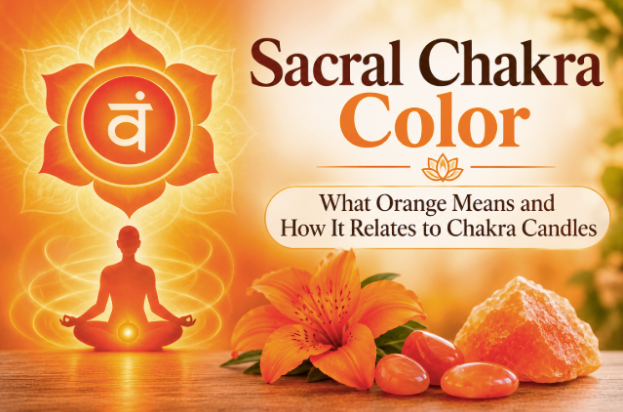
The sacral chakra color is orange, a shade commonly associated with creativity, emotional expression, pleasure, and vitality. Known as Svadhisthana in Sanskrit, the sacral chakra is the second of the seven primary chakras in modern chakra teachings. Its traditional position is in the lower abdomen, below the navel, and its symbolism reflects the ability to experience emotions, explore ideas, and enjoy life’s experiences.
Orange represents warmth, movement, and creative energy. Within chakra practices, this color is often used as a visual reminder to welcome inspiration, acknowledge feelings, and make room for personal expression.
A sacral chakra candle can be used in a meditation or self-care context to bring this symbolism to life. An orange candle provides the visual cue of Svadhisthana and helps to create the right environment for meditation, for affirmations or simply for some quiet time.
Understanding the significance of orange in relation to the sacral chakra can help you engage in these practices with greater intention. This guide looks at what orange represents in terms of the chakra, how it’s different from the other chakra colors and how you can use an orange candle in your own personal practice.
What Is the Sacral Chakra Color?
Orange is the color most commonly associated with the sacral chakra in the contemporary seven chakra teachings. It’s the color of the themes traditionally associated with Svadhisthana (creativity, emotion, pleasure, relationship, adaptability, etc.).
In chakra terms, the colors represent the various energy centers and their associated qualities. Orange is the color used to denote warmth, enthusiasm, movement and the freedom to go and explore.
The sacral chakra is the second chakra in the seven chakra system (root chakra, sacral chakra, solar plexus chakra, etc.). It’s the one associated with orange, which is a distinct color from the red and yellow of the root and solar plexus chakras, respectively.
Although orange is the color that’s used in most modern chakra charts, it’s by no means a universal association and can vary quite significantly between traditions and interpretations. It’s best viewed as a symbolic link rather than something that’s actually a property of the body.
Why Orange Is Associated With the Sacral Chakra
The orange and the sacral chakra are linked in the same way as the other chakra/color pairings, with orange representing the qualities of the sacral chakra as described in modern chakra teachings (creativity, emotional flow, pleasure, the ability to adapt to change, etc.).
Orange is the color of warmth and enthusiasm and is also a very attention-grabbing color, which can create a sense of energy in a room. It’s very much the color you’d associate with the sacral chakra and its link to creative expression and pleasure.
The sacral chakra is also linked to the element of water. Water represents movement, fluidity and flexibility and is a reminder of the importance of allowing things to flow rather than constantly fighting against change.
Orange and water together provide two perfectly complementary symbols for Svadhisthana. Orange is the color of warmth and creative energy. Water is the element of emotion, movement and flexibility.
You can use these associations as prompts for self-reflection. With the sacral chakra, for instance, you might ask yourself if you make time for the things you enjoy, if you’re able to express your feelings freely, and if you’re open to new ideas.
Orange in Modern Chakra Teachings
In modern chakra work each of the seven main chakras is generally assigned a particular color. These colors create a recognizable visual system that helps people distinguish between the energy centers and their associated themes.
Orange is the sacral chakra; the other colors are generally arranged in a sequence from red at the root chakra to violet at the crown chakra.
This association with the color is present in meditation manuals, chakra diagrams, spiritual décor, and all sorts of well-being products. Orange clothing, orange artwork, orange crystals, orange candles, etc., can all be used as a visual cue to the symbolism of the sacral chakra.
However, it’s important to note that the rainbow sequence of chakras is very much a modern Western thing. It shouldn’t be assumed to be a feature of every chakra tradition throughout history.
For everyday spiritual practices, orange provides a simple way to connect with the themes of Svadhisthana. You might introduce the color through a candle, a journal cover, a meditation space, or another object that reminds you of your intention.
What Does Orange Represent in Sacral Chakra Symbolism?
Orange is linked to a number of qualities that again reflect the traditional connotations of the sacral chakra. It’s all about creativity, emotional awareness, enjoyment and the ability to live in the moment.
Understanding these associations can help you to work out which of the various aspects of your personal development you might wish to explore via meditation or some other form of self-care.
Creativity and Self-Expression
Creativity is one of the key themes of the sacral chakra. The orange color of the chakra is associated with the freedom to be creative, explore your ideas, experiment and express yourself in a way that is truly meaningful.
Creative expression does not have to involve artistic talent or professional achievements. It could be as simple as trying a new recipe, decorating the house, writing in a journal, picking up an instrument or just doing something for yourself.
In the Svadhisthana context, these are the activities that represent an opportunity to go beyond the ordinary, to make space for the imagination.
Orange is frequently used as a visual cue to the creative potential. If you see the color during meditation, you can use it as a trigger to think about what interests you have perhaps neglected or what new experiences you’d like to go on to explore.
For instance, you might think about a hobby that you’ve dropped because your schedule has gotten so full. A brief meditation followed by the decision to actually do that hobby can turn a general intention into something you can actually go and do.
The purpose is not to force creativity or expect immediate inspiration. The symbolism of the sacral chakra is simply to encourage you to stay curious and to give yourself the freedom to play around.
Emotions, Pleasure, and Vitality
The sacral chakra is also traditionally linked with emotional expression and the capacity to experience pleasure. Its orange color is associated with warmth, movement and an openness to the different experiences of life.
Emotional awareness is about being able to recognize how you feel and then thinking about what that might be telling you in terms of your needs and your preferences. It’s not about just dismissing the uncomfortable feelings; it’s about taking the time to actually become aware of them and then responding in an appropriate way.
Pleasure is another key element of this symbolism. Everyday enjoyment may come from listening to music, spending time outdoors, preparing a favorite meal, or connecting with people you care about.
These experiences needn’t be the extraordinary sort. The sacral chakra is a constant nudge that personal pleasure and emotional connection are valid and important things that deserve their own space in our lives just as much as the more ‘normal’ day-to-day responsibilities.
Its association with vitality also speaks of enthusiasm and being engaged with life. You can use that symbolism to think about whether your own routines leave you enough space for things that actually make you feel interested, inspired and connected.
An orange candle can be used to provide a visual cue to the qualities you’d like to be exploring.
How the Sacral Chakra Color Differs From Other Chakra Colors
The seven chakra system uses different colors to represent the qualities of each of the energy centers. Knowing the difference can help you to pick a particular focus for meditation and will also help to avoid the common mistake of confusing the sacral chakra with the ones above and below it.
Orange is the traditional color for Svadhisthana, red for the root chakra and yellow for the solar plexus chakra.
Sacral Chakra Orange vs. Root Chakra Red
Red is the color of the root chakra (Muladhara), which is the first of the seven chakras and is situated at the base of the spine. It is the color of grounding, security, stability and connection to the physical world.
Orange is the sacral chakra (sacral following the root in the traditional sequence) and is generally located in the lower abdomen, below the navel.
Although both colors are linked to different facets of the personal experience, their symbolism is for very different purposes.
Red is the color of stability and security. Orange is all about creativity, emotion, pleasure and adaptability.
A root chakra meditation might be focused on a sense of stability and connection to your environment. A sacral chakra meditation could be about your creative interests, your emotional expression or the importance of making time to enjoy yourself.
Choosing between red and orange therefore comes down to the intention of your practice. Both can be used as part of a wider chakra-based practice, but orange is the traditional choice if you’re going to be working specifically with Svadhisthana.
Sacral Chakra Orange vs. Solar Plexus Chakra Yellow
Yellow is the color of the solar plexus chakra (Manipura), which is the third chakra and is situated in the upper abdomen.
Its symbolism is confidence, determination, personal power and decision-making.
Orange, by comparison, represents the sacral chakra’s connection with creativity, emotional awareness, pleasure, and relationships.
The difference becomes easier to understand when considering the themes associated with each color. Orange encourages exploration and creative expression, while yellow represents the confidence to make decisions and take action.
For example, you might use orange as a visual reminder when reflecting on a creative idea you want to explore. Yellow could represent the confidence and determination needed to turn that idea into a practical project.
Both colors are part of the commonly described chakra system, but they provide different symbolic focuses for meditation and self-reflection.
What Is an Orange Sacral Chakra Candle?
An orange sacral chakra candle represents the symbolism of the Svadhisthana chakra. The color of the candle is a visual reference to the sacral chakra and the attributes that are traditionally ascribed to it (creativity, emotion, pleasure, etc.).
For many people, candles are a familiar part of meditation and self-care routines. You’ll often find a candle lit to mark the beginning of a quiet moment and the flame itself can be a very useful focal point during the act of breathing, visualization or journaling.
An orange candle adds a specific symbolic element to this experience. It’s a reminder of your intention to go in and explore creativity, to acknowledge your emotions or to simply make space for some enjoyable stuff.
The candle in itself doesn’t have any proven ability to activate or balance an energy center. Its function is to add to the atmosphere and to the personal significance of your ritual.
The Connection Between Candle Color and Chakra Symbolism
Color is a very important element in a great many chakra-based practices. Different hues are used to represent the qualities of the various energy centers and, as such, are a very useful visual aid during meditation and contemplation.
For the sacral chakra, orange is the traditional choice in modern chakra work. It’s all about warmth, creativity and the flow of emotion and vitality.
An orange candle can help bring this symbolism into your environment. Light it prior to meditation and the color can act as a reminder of the intention you’re working with.
If you’re looking at creative expression, you might use the candle as a focal point and think about a project you’d like to get involved in. If it’s emotional awareness you’re after, then you could use the candle and the candlelight to go along with some journaling about a recent experience.
The meaning is in the relationship between the color, the intention and the activity you choose. You don’t need to go to any great lengths to make it personal.
What to Look for When Choosing a Sacral Chakra Candle
Choosing a sacral chakra candle is more than just picking an orange one. You need to think about how it fits in with your meditation space, what fragrance you like and all the practicalities of the experience.
Color and design: Orange is the most recognizable color associated with Svadhisthana in modern chakra teachings. Look for a shade and design that complement your meditation space and reinforce the symbolism you want to explore.
Fragrance: Consider whether you prefer citrus-inspired, floral, fresh, or warm fragrance notes. Choose a scent that you find comfortable and pleasant, particularly if you plan to use the candle during quiet meditation.
Ingredients: Check the product description for details about the wax blend and fragrance ingredients. Understanding what goes into a candle helps you make a more informed purchasing decision.
Size and burn time: Consider the candle’s dimensions, net weight, and estimated burn time. These specifications can help you decide whether it suits shorter meditation sessions or longer periods of use.
Overall presentation: The vessel, label, and packaging can contribute to the experience, particularly if you intend to keep the candle as part of your regular self-care setup.
At Chakra Spot we have candles that are inspired by the chakras. They’re all about the combination of color, scent and personal ritual. Take a look at the range to see if any of the candles speak to you in terms of your own meditation and mindful living practice.
How to Use an Orange Candle in a Sacral Chakra Ritual
An orange candle can be part of your sacral chakra practice. You can use it in a meditation, a visualization or an affirmation practice without any special equipment at all and with no complex setup required.
The following are some ideas to get you started. Pick the one that feels right to you and then tweak the routine to suit your own preferences.
Orange Candle Meditation
Orange candle meditation gives you the opportunity to focus on the symbolism of Svadhisthana and to create a quiet moment for yourself.
Start by picking a comfortable spot where you can sit without any undue distractions. Position your orange candle on a stable, heat-resistant surface, away from curtains, paper, bedding, and other flammable materials.
Light the candle if it’s safe to do so. Sit up comfortably and just let your breathing settle into its natural rhythm.
You can look gently toward the flame for a short period, using its light as a visual focal point. Or you can close your eyes and simply bring your attention to your breathing.
As you get into the practice, think about one theme relating to the sacral chakra. That could be creativity, emotional awareness or just simply making time for yourself.
There’s no need to force a particular feeling or experience. Just let your thoughts come and go and gently return to your intention whenever your attention has wandered.
Spend a few minutes with the practice and finish by identifying one small action you can take to support your intention. That could be starting a creative activity, writing in a journal or simply setting aside some time to do something you enjoy.
Sacral Chakra Visualization With Candlelight
Visualization can be another dimension to a sacral chakra ritual. It’s about using your imagination to focus your attention on a particular idea, a particular feeling or an intention.
For this practice the orange candle is a visual cue to the traditional color of the sacral chakra.
Start by sitting comfortably and directing your attention to the candle. Just observe the color of it and the movement of the flame; don’t stare at it continuously or strain your eyes.
Once you’re settled, close your eyes if you’re comfortable and just imagine a soft orange glow in the lower abdomen, below the navel. That’s the traditional position associated with Svadhisthana.
You can connect the visualization with a personal intention. For instance, you could imagine the orange glow as a reminder to go out and explore some new creative experiences or to approach your emotions with a bit more understanding.
If visualization does not come naturally, there is no need to force it. Just thinking about the color orange and what it represents will be sufficient to get you going.
The aim of the exercise is to create a mental link between the color, the sacral chakra and your intention. It’s a personal meditative technique rather than a method of producing some kind of tangible energetic or physical outcome.
Pairing Candle Rituals With Affirmations
Affirmations are just short statements that you use to focus on a particular intention or personal value. When used in conjunction with an orange candle, they can form a very simple structure for sacral chakra meditation.
Choose an affirmation that reflects what you want to explore. For example, someone focusing on creative expression might choose, “I welcome new ideas and give myself permission to create.”
Other sacral chakra affirmations include:
- “I make room for creativity and self-expression.”
- “I acknowledge my emotions with patience and understanding.”
- “I allow myself to experience joy and meaningful connections.”
- “I welcome change and remain open to new experiences.”
- “I respect my needs and express myself honestly.”
You do not need to repeat every statement. Choose one that feels relevant and repeat it silently while breathing comfortably.
You can also write your affirmation in your journal prior to lighting the candle. After meditation, think about whether there’s a practical action you can take to support the intention.
An affirmation around creativity might be one that nudges you to get back into a hobby you’ve long since abandoned. An affirmation around emotional awareness might be one that prompts you to pause and actually take some time to understand how you’re feeling before you react to a tricky situation.
Always have an open-flame candle on a stable, heat-resistant surface, and never leave it unattended.
Frequently Asked Questions
Is Orange Always the Sacral Chakra Color?
Orange is by far the most widely recognized sacral chakra color in the contemporary seven chakra teaching. That said, color associations can differ from tradition to tradition and from interpretation to interpretation. It’s really more of a symbolic link that’s been adopted by a lot of people rather than a universal one.
Can You Use an Orange Candle for Sacral Chakra Meditation?
Yes, an orange candle can be used as a visual anchor in a sacral chakra meditation. In modern chakra terms, orange is the color of creativity, emotional expression and vitality, so it’s quite appropriate to have one in there as part of a personal meditation or a personal reflection.
What Other Colors Are Associated With the Sacral Chakra?
Orange is the primary color associated with the sacral chakra in modern chakra teaching (some people will include various shades of orange and/or related warm colors, but orange is the color that is most widely used). Red and yellow are the colors traditionally associated with the root and solar plexus chakras, respectively.
Bring the Energy of Orange Into Your Chakra Ritual With Chakra Spot
Understanding the sacral chakra color offers a simple way to explore the symbolism of Svadhisthana and its connection with creativity, emotional expression, pleasure, and vitality. Orange represents these qualities in contemporary chakra teachings and can serve as a visual reminder to make room for meaningful experiences.
An orange candle can complement this intention by creating a dedicated atmosphere for meditation, visualization, and affirmations. You can keep your ritual simple, focus on one personal intention, and use candlelight as a reminder to reconnect with your creative interests and everyday experiences.
Explore Chakra Spot’s chakra-inspired candle collection to find a candle that enhances your meditation and self-care routine. Make time for reflection, welcome creative expression, and bring greater intention to the moments that matter the most to you.