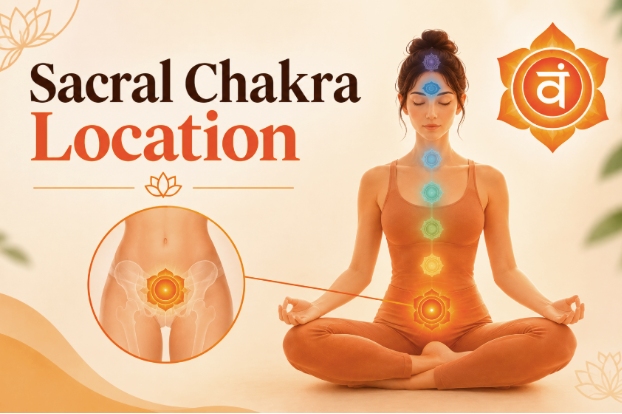
The sacral chakra location is traditionally described as being in the lower abdomen, situated below the navel and above the pelvic area. In Sanskrit this energy center is called Svadhisthana. In most chakra traditions, it is the second of the seven main chakras. It is usually linked with creativity, emotions, pleasure, and the capacity to adapt to change.
Understanding where the sacral chakra is located can help you explore chakra-based meditation and develop a personal mindfulness routine. Since the sacral chakra is part of a traditional spiritual system, its location is symbolic and not based on a specific anatomical point in the body.
A candle that is used for the sacral chakra can help to create a calm atmosphere and serve as a visual focus when meditating. If you are just beginning to practice chakra work or if you already have a regular ritual, then combining relaxed breathing, concentrated attention, and candlelight can provide a special time for reflection.
In the guide, you will learn about the traditional location of the sacral chakra, the way in which it is different from the root and solar plexus chakras, and also how to use a candle in your meditation practice safely.
Where Is the Sacral Chakra Located?
The sacral chakra is usually situated in the lower abdomen, midway between the navel and the pelvic area. In some traditions the spot is described as being a little way below the navel, whereas in others it is linked with the lower pelvis or the sacral region.
Keep in mind that these descriptions concern a traditional energy center and not a physical structure that can be identified by an anatomical examination.
In practices involving the chakras, the area in the lower abdomen is used as a focus for thinking about one’s emotions, creativity and personal experiences, and you can employ this traditional posture as a point of meditation without having to pinpoint an exact location on your body.
The Sacral Chakra’s Position in the Lower Abdomen
The area located below the navel and above the pubic region is usually linked with the sacral chakra; the Sanskrit name for this chakra, Svadhisthana, is traditionally associated with the concept of one’s own dwelling place.
In modern chakra teachings this place is generally connected with emotional expression, creativity, pleasure and the flow of experiences. The chakra is also linked with the element of water, this element symbolizing movement, adaptability and change.
While you are concentrating on your sacral chakra, slowly focus your attention on your lower abdomen. Simply observe the way you are breathing without forcing your stomach to expand or contract. Additionally, you could picture a warm orange glow in that general area if your spiritual practice includes visualization.
There is no need to press/touch your abdomen or apply any pressure to it. All that is required is to use the conventional position as a point of mental concentration rather than for the purpose of identifying or stimulating a physical organ.
The fact that it is accessible to those who are just starting out means that you can investigate the symbolism of Svadhisthana by means of deep breathing and reflection, even if you have no prior experience of chakra meditation.
The Sacral Chakra and the Pelvic Region
The pelvic area is also one of the regions commonly linked with the sacral chakra; this is because traditional chakra systems relate various energy centers to different parts of the body and to certain aspects of human experience.
In current interpretations the sacral chakra is usually connected with emotional awareness, relationships, sensuality, and creative expression, and since it is linked with water, the themes of flexibility and movement are reinforced.
The sacral chakra is not the same as the sacrum, which is a triangular bone situated at the base of the spine; although the two names are linked in everyday use, they refer to different things.
The sacral chakra must not be confused with the pelvic organs, the reproductive system, or the nervous system since the latter are physical anatomical structures, and Svadhisthana is a concept in the spiritual traditions.
This knowledge enables you to carry out the practice correctly, allowing you to concentrate on the lower abdomen or pelvic area while not assuming that the chakra is associated with a specific organ or that it has a medically measurable effect on that area.
How to Identify the Sacral Chakra’s Location
To identify where the sacral chakra is located, you have to know its usual position and use that as a reference when you are meditating; no special equipment or physical examination is needed if you want to include this practice in your routine.
Begin by sitting or lying down in a comfortable position so that you can breathe naturally. Pay attention to the location of your navel and think about the area underneath it, going on down to the pelvis. This area is the one usually targeted as the Svadhisthana in most contemporary explanations of the chakras.
At this stage you should turn your attention to that area while at the same time thinking about a personal intention concerning creativity, emotional awareness, or self-expression. The aim is to develop a steady concentration during meditation rather than to identify a specific anatomical point.
Understanding Its Traditional Position in the Body
The sacral chakra is said by a great many modern chakra guides to lie a short way below the navel; some give a measurement of about two finger-widths, whereas other descriptions refer to a wider area of the lower abdomen and pelvis.
The different interpretations stem from the way various chakra traditions and contemporary wellness practices describe the body’s subtle energy centers. Indeed, there is no widely accepted anatomical measurement of the sacral chakra.
For the purpose of meditation, you only need to know the general area, so place your attention on the region below your navel, relax your abdominal muscles and let your breathing stay comfortable.
You can use the following simple exercise:
- Sit in a comfortable position with your back supported.
- Let your shoulders relax and take a few natural breaths.
- Bring your attention to the lower abdomen without pressing on it.
- Imagine an orange light in that general area, if visualization feels comfortable.
- Reflect on an intention related to creativity, emotional awareness, or personal growth.
Spend a few minutes with this practice, allowing thoughts to come and go without forcing a particular result.
The usual position of the sacral chakra is used as a point of reference in meditation. It is not necessary for you to feel warmth, tingling, a movement, or any other physical sensation in order for you to successfully carry out the exercise.
Where the Sacral Chakra Sits Relative to Other Chakras
In the seven chakras, the sacral chakra is the second. It is easier to understand the traditional order from the base of the spine to the top of the head if one knows where the sacral chakra is in relation to the others.
When studying the positions in the lower body, the first three chakras are especially relevant.
The root chakra, known as Muladhara, is normally situated close to the base of the spine. The sacral chakra, or Svadhisthana, is found in the lower abdomen or pelvis area. The solar plexus chakra, named Manipura, is usually linked with the upper abdomen.
These are only approximate descriptions within a spiritual context and not physical points determined by medical science.
You are able to tell them apart by using their traditional positions as mental reference points, the root chakra standing for grounding and security, the sacral chakra being connected with emotions and creativity, and the solar plexus chakra relating to confidence and personal power.
If you understand the sequence, then you will be in a position to select a particular area of focus for your practice instead of viewing all chakra meditations as being the same.
Sacral Chakra vs. Root Chakra vs. Solar Plexus Chakra
In the traditional chakra system the sacral, root, and solar plexus chakras are relatively near to each other. This closeness may make it hard for beginners to remember where they are and what their symbolism is.
The simplest method of telling them apart is to look at their roughly given positions and examine the themes that are traditionally associated with them.
Differences in Location and Traditional Meaning
| Chakra | Traditional location | Commonly associated themes | Traditional color |
| Root chakra (Muladhara) | Base of the spine | Grounding, security, stability | Red |
| Sacral chakra (Svadhisthana) | Lower abdomen and pelvic region | Emotions, creativity, pleasure | Orange |
| Solar plexus chakra (Manipura) | Upper abdomen | Confidence, determination, personal power | Yellow |
This reflects the common way that the concept is currently understood. The descriptions of the positions and colors of the chakras may vary between different spiritual traditions.
The root chakra is linked with a feeling of stability and with one’s connection to the environment, and its symbolism can be used as a focus during meditation when you are thinking about security, your routines, or simply feeling grounded.
The sacral chakra directs attention towards emotional experience, creative expression, and enjoyment; its usual position below the navel serves as a reference point for meditation focused on these themes.
The solar plexus chakra is associated with personal confidence and the ability to make decisions. Its position is generally described as higher in the abdomen, around the stomach area.
If you are selecting a focus for meditation, then think about the aspect you would like to examine; for example, you could reflect on stability by concentrating on the root chakra, on creativity by concentrating on the sacral chakra, or on confidence by concentrating on the solar plexus chakra.
You do not need to meditate on all three at the same time. Focusing on one chakra and its related themes can make your routine easier to follow, especially when you are just starting.
How to Meditate on the Sacral Chakra
Sacral chakra meditation involves focusing on the usual position in the lower abdomen. The practice may incorporate comfortable breathing, visualization, affirmations, or simple reflection.
You do not need to master a complicated technique. A few uninterrupted minutes can provide an opportunity to slow down and reflect on the themes associated with Svadhisthana.
Finding a Comfortable Meditation Position
Select a position so that you stay comfortable during your meditation; you can sit on a cushion, use a supportive chair, or lie down if that makes it easier to relax.
When you are sitting, make sure that your feet are resting on something and that your back is kept straight and comfortably upright. Relax your shoulders and get rid of any unnecessary tension in your jaw and abdomen.
Let your breathing adjust to its normal rhythm since there is no requirement to take very deep breaths, hold your breath, or force your breathing pattern.
When you are at ease, select a simple intention for the session; for instance, you could aim to make space for a creative project, to gain an understanding of a recent emotional experience, or simply to spend a few minutes free from daily distractions.
Staying specific about your intention can help make it easier to carry out the practice. Rather than aiming to improve every aspect of your life, choose one topic that seems relevant to you right now.
If your sitting becomes uncomfortable, then change your position. Meditation does not demand that you ignore any pain or physical discomfort.
Focusing Your Attention on the Lower Abdomen
When you have got yourself into a comfortable position, turn your attention gently to the area in the lower abdomen, below the navel. Think of this as a general region to concentrate on and not as an exact anatomical location.
Pay attention to the way you are breathing naturally. You might notice the abdomen moving a little as you breathe in and out. You should not attempt to alter that movement.
If it helps, picture a gentle orange light in the lower abdominal area, since orange is generally linked to the sacral chakra in current chakra teachings and thus serves as a useful mental image of Svadhisthana.
You might likewise repeat to yourself a simple affirmation, for example, “I make room for creativity and emotional awareness.”
If your attention begins to drift, go back and focus on your breathing or on the intention you have selected. Thoughts will naturally come up when you are meditating, and it is not necessary for you to get rid of them in order to carry on.
After a few minutes, consider taking one small action that supports your intention; for example, you could plan some time for drawing, write down an emotion that you would like to understand, or leave space for an activity that you truly enjoy.
The last stage is about linking meditation with ordinary life; its aim is to provide an opportunity for reflection, not to ensure a physical or energetic change.
How to Use a Candle During Sacral Chakra Meditation
A sacral chakra candle can help in creating a special atmosphere for meditation; the light from it provides a visual focus, and preparing the space serves as a signal that it is time to stop and concentrate on your intention.
Candles linked with the sacral chakra usually have an orange color or feature designs based on Svadhisthana; alternatively, you can use a normal candle if that is the one that suits you better.
The worth of the ritual stems from the attention and significance that you give it; while candlelight may help to create the atmosphere, it has not been scientifically proven as a way of balancing the chakras or treating physical or psychological conditions.
Setting Up a Calm Meditation Space
Select a calm and comfortable place in which you can meditate without suffering from unnecessary interruptions. Make the area simple so that your attention can be focused on your breathing and on your intention rather than being distracted by the need to arrange fancy decorations.
Put the candle on a flat, steady, and heat-resistant surface; keep it well clear of curtains, paper, bedding, clothing, loose hair and any other flammable materials; and adhere to the guidelines given by the candle manufacturer about placement and burning time.
A meditation cushion, a journal, or a small item that reminds you of your intention might be included, and an orange cloth or decorative object can also reinforce the traditional color symbolism of the sacral chakra without making the arrangement too complicated.
Before you light the candle, think about what you would like to focus on; this could be related to creativity, emotional awareness, or merely allowing yourself a few quiet minutes.
Using Candlelight as a Focus for Meditation
When your area is ready, get comfortable and focus your attention on the candle. If this seems okay, you can gently look at the flame, or else close your eyes and use the candle as a reminder of your intention.
You shouldn’t look at the flame for long periods if that causes your eyes to become strained or uncomfortable, and it is not necessary to keep your eyes open in order for the practice to be meaningful.
After a short while, turn your focus to the lower abdomen, which is the usual place of the sacral chakra, and at the same time keep your breathing normal as you think about the topic you have chosen.
You can combine this focus with a simple affirmation, such as:
“I allow myself to explore new ideas and experiences.”
Repeat the affirmation silently if it helps you concentrate. Alternatively, remain quiet and notice the thoughts that arise.
The candle acts as an external focal point, while your breathing and the intention you have selected serve to guide the meditation; you can easily shift your attention between the two instead of attempting to keep perfect concentration.
Never leave a burning candle unattended, even during a short meditation. It must be put out before you go into the room or if you start to feel drowsy.
A Simple Sacral Chakra Candle Meditation Routine
It is possible to carry out a brief routine that takes about five to ten minutes by combining the usual position of the sacral chakra with the use of candlelight.
Step 1: Prepare the space. Find a comfortable place and position your candle safely on a heat-resistant surface. Light it only when you can remain attentive to the open flame.
Step 2: Choose your intention. Decide whether you want to focus on creativity, emotional awareness, or personal expression. Keep your intention simple enough to remember throughout the session.
Step 3: Settle your breathing. Sit comfortably and take a few natural breaths. Let your shoulders relax and allow your attention to move away from daily distractions.
Step 4: Focus on the sacral chakra location. Direct your attention to the lower abdomen below the navel. If you find visualization helpful, imagine a soft orange glow in the area.
Step 5: Use the candle as a focal point. Look gently toward the candle when comfortable, or close your eyes and return your attention to your breathing. Repeat your intention silently if needed.
Step 6: Finish with reflection. Consider one practical action you can take after meditation. Write it in a journal or keep it in mind as you return to your routine.
Step 7: Close the session safely. Extinguish the flame using an appropriate method and allow the candle to cool according to its care instructions.
You can carry out this practice at any time when it suits your routine; on certain days you might choose to spend a longer time in meditation, while on other days a short period of quiet reflection will be sufficient.
The goal is to establish a feasible ritual that promotes mindfulness and personal reflection, without requiring that each session be different.
Frequently Asked Questions
Is the Sacral Chakra Below the Navel?
Yes, the sacral chakra is generally located in the lower abdomen, and meditation can focus on this area without requiring precise anatomical identification.
Is the Sacral Chakra a Physical Organ?
No, the sacral chakra is a spiritual energy center associated with the lower abdomen, not a physical organ recognized by modern medicine.
Should You Place a Candle Near the Sacral Chakra?
Do not place a burning candle on your body. Instead, position it on a stable, heat-resistant surface away from flammable materials, while focusing your attention on the lower abdomen during candle meditation.
Explore Chakra Spot’s Candles for Your Meditation Ritual
If you want to carry out chakra meditation with greater clarity, then you should understand the sacral chakra location. In traditional terms it is placed in the lower abdomen and in the pelvic area, and as the second chakra within the widely described seven-chakra system, it is linked with creativity, emotions and personal expression.
You may choose to use this conventional place as a focus when meditating, without considering it to be a physical organ or without attempting to pinpoint an exact anatomical location; comfortable breathing, visualization, and a clear intention will make the practice suitable for both those who are just starting and for more experienced meditators as well.
A candle dedicated to the sacral chakra can help out your routine by establishing a calm atmosphere and serving as a visual cue to pause. It should be placed on a stable, heat-resistant surface at a distance from your body.
Explore Chakra Spot’s chakra-inspired candle collection to discover one that matches your own meditation routine. Make a quiet space, set an intention, and take a few mindful moments to reconnect with your creativity and your inner experiences.