
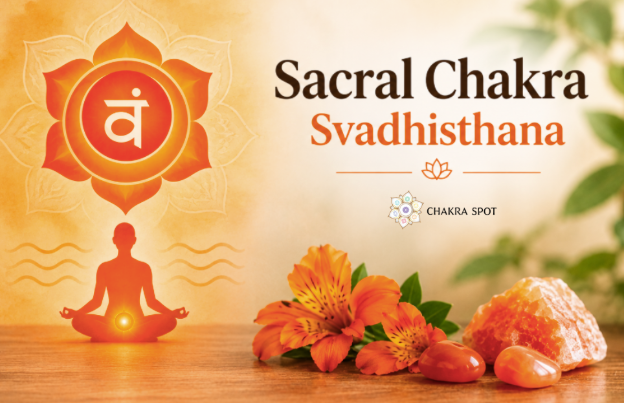
The sacral chakra meaning (Svadhisthana) is all about creativity, emotional expression, pleasure and the ability to enjoy life. It’s the second of the seven main chakras and is the chakra of the emotions, of creative energy and of personal experience.
Often associated with the color orange and the element of water, the sacral chakra is all about movement, flexibility and the freedom to be yourself. Exploring its meaning can encourage greater self-awareness and help you reflect on how you approach relationships, creativity, and everyday enjoyment.
A sacral chakra candle can be used to create a calm atmosphere for meditation, journaling or simply for personal reflection. The light can be a gentle nudge to stop and take time out to reconnect with your own intentions and to make space for the more meaningful experiences.
This guide is about the symbolism of the sacral chakra, the benefits that are linked to it and how you can actually put a candle to use in your self-care.
What Is the Sacral Chakra?
The sacral chakra is the second of the seven chakras (the one traditionally associated with the lower abdomen just below the navel) and is concerned with emotion, creativity, pleasure and relationships.
In chakra terms this is the energy center relating to your ability to feel, your ability to adapt to change, and your ability to engage with life in a creative way. The symbolism is that you should be able to feel your emotions without necessarily pushing them away and that you should be able to discover what it is that really inspires and delights you.
The sacral chakra is typically portrayed as orange (signifying warmth, vitality and creative expression) and is also associated with water (movement, fluidity, and the flow of emotion).
You don’t need any kind of elaborate spiritual practice at all to work with this symbolism. Meditation, creative work, journaling and simply being aware can all be ways of beginning to explore the themes of this chakra.
The Meaning of Svadhisthana
Svadhisthana is the Sanskrit name for the sacral chakra. It’s usually interpreted as ‘one’s own dwelling place’ or ‘the place where one’s being is established.’
Within chakra terms this is an invitation to go back to your inner experience of yourself, your feelings, your desires, your imagination, your sense of fun, etc.
Rather than seeing emotions as a distraction, the sacral chakra is about noticing what you’re feeling and then asking yourself what that might be telling you about your needs, your values and your preferences.
It’s also associated with water, which is, of course, a very powerful symbol in its own right. Water changes direction, it flows with the land, and it is adaptive. The sacral chakra is all about the ability to grow, the ability to be open to new experiences and the ability to respond to life as it happens.
A simple way to reflect on Svadhisthana is to ask yourself, “Am I making enough room for creativity, emotional honesty, and enjoyment in my everyday life?”
The Sacral Chakra in the Seven-Chakra System
The seven-chakra system is a series of energy centers, each associated with different aspects of the human experience. The sacral chakra is the second of these, following the root chakra and preceding the solar plexus chakra.
The root chakra is all about stability and security. The sacral chakra takes that as a foundation and adds in the realms of emotion, creativity and pleasure. The solar plexus chakra then builds on that with confidence, personal power and determination.
Understanding these connections can help you explore chakra symbolism as a broader framework for self-reflection.
The sacral chakra’s traditional associations include:
- Position: Lower abdomen, below the navel.
- Color: Orange.
- Element: Water.
- Sanskrit name: Svadhisthana.
- Main themes: Emotions, creativity, pleasure, relationships, and adaptability.
These associations, of course, will vary from tradition to tradition and from modern interpretation to modern interpretation. They provide a spiritual framework for meditation rather than any kind of scientifically valid description of the anatomy of the body.
What Does the Sacral Chakra Represent?
The sacral chakra is the chakra of the emotional and creative aspects of life. It’s all about how you feel, how you express yourself, how you relate to people and what you enjoy doing.
Understanding these themes can help you to reflect on your own habits and work out where you might like to create a bit more balance in your day.
Emotions and Emotional Expression
Emotion is one of the key aspects of the sacral chakra. It’s about being able to feel your emotions, to be aware of them and to be able to express them in a healthy way.
Emotions in real life can be a bit of a mystery. You can be quite disappointed and have no idea why. You can find yourself unable to say what it is you actually need and you can very easily be overlooking your own emotions while you’re busy with all the other things you’ve got to do.
Sacral chakra work is about learning to simply stop and just look at the experience rather than just dismissing it. The opportunities to do that are in journaling, in quiet meditation and in having some really thoughtful conversations.
For example, you might spend a few minutes writing about a situation that made you feel uncomfortable. Rather than jump straight into solving the problem, you’d look at what actually happened, how you reacted and what you need now.
This process can support emotional awareness without you having to go through the exercise of labelling every emotion as either positive or negative. The whole point is to be more curious and more compassionate towards your inner experience.
Creativity, Pleasure, and Relationships
Creativity is another key element of the symbolism of the sacral chakra. It’s about your ability to experiment, to imagine the possibilities and to express yourself in a way that is meaningful.
Creativity doesn’t have to be about professional art. You can be creative by coming up with a new recipe, arranging flowers, dancing, painting, gardening or doing some other kind of personal project.
The sacral chakra is also associated with pleasure and enjoyment. That brings us back to the point that you should be looking at what activities in your life actually allow you to feel like you’re living rather than just being productive.
Relationships are another facet of this symbolism. The sacral chakra can be a prompt to look at how you share your feelings, how you respect the needs of others and how you set your own personal boundaries.
Together these associations promote a more considered way of living. They encourage you to make space for fun, to be yourself and to build relationships that respect the individual needs and desires of everyone involved.
What Are the Benefits Associated With the Sacral Chakra?
The sacral chakra in the various spiritual traditions is all about creativity, emotional awareness, pleasure and connection. That could be a very useful framework for some personal exploration and mindful activities.
The benefits people speak of in relation to sacral chakra work are best seen as intentions or areas of personal development rather than as the actual results of activating or balancing the chakra.
Creative Expression and Emotional Awareness
Focusing on the sacral chakra can encourage you to make time for creative activities and pay closer attention to your emotional experiences.
When your day-to-day life takes over, creative pursuits get pushed to the back of the queue. You’ll quite possibly put off working on a personal project, you’ll quite possibly give up on a hobby that you enjoy and you’ll quite possibly find yourself in need of a good practical reason to spend any time at all on something you’re interested in.
A sacral chakra ritual can be used to create a dedicated moment to go back to those interests. Just light a candle, sit quietly and identify one creative pursuit that you’d like to try. That’s a way of taking a general intention and turning it into a concrete action.
You can also use the ritual to reflect on your emotions. Consider asking yourself three questions:
- What have I been feeling recently?
- Which activities make me feel engaged or inspired?
- What could I do this week to give myself more room for creative expression?
You do not need to find immediate answers. The purpose is to develop a habit of reflection and approach your experiences with greater attention.
Self-Expression and Personal Boundaries
The sacral chakra’s connection to relationships and emotional expression can also be a place of reflection on personal boundaries.
Healthy boundaries allow you to communicate what is OK with you, to know your own limits and to respect the limits of others. That might be saying no to an unreasonable request, asking for some time to think or simply being more clear about what you want.
Thinking about these situations will help you to consider whether your choices are in fact in line with your own needs and values.
For example, in a fairly quiet candle ritual, you might be looking back on a situation where you’d agreed to do something you didn’t want to do. What was it about that situation that made the decision so difficult? How could you have handled it differently the next time?
The point isn’t to beat yourself up about past decisions. It’s to use the sacral chakra as a symbol that self-expression is about being in touch with your feelings and expressing them in an appropriate manner.
What Is a Sacral Chakra Candle?
A Svadhisthana sacral chakra candle is one that’s been selected or designed for use in a sacral chakra-inspired ritual. These candles commonly incorporate orange colors, warm fragrance profiles, or other design elements associated with Svadhisthana.
For so many people a candle is just a focal point in meditation or reflection. You’re looking at the flame; you’re focusing on the flame, and lighting it can be the cue that you’ve actually begun your period of meditation/reflection/self-care.
A candle can also be used to create a consistent atmosphere for journaling, for breathing exercises and indeed for any number of other personal rituals. Its value is in the meaning you give it and the intention you bring to the practice.
Chakras are spiritual systems rather than scientifically validated anatomical systems. A candle is therefore a tool for the atmosphere and for your own personal reflection rather than a proven method of balancing your energy or treating a health condition.
How Chakra Candles Fit Into Spiritual Practices?
Chakra candles can be used as part of a spiritual practice, which may involve meditation, affirmations, visualization and journaling.
For example, someone working with the sacral chakra might go for an orange candle to represent creativity and the flow of emotion. They’d be breathing and contemplating their personal intention in that situation.
Affirmations can also be part of the experience. ‘I allow myself to explore my creativity’ is a very simple affirmation that serves as a reminder of the intention.
The candle does not need to produce a particular feeling or experience for the ritual to be meaningful. Some sessions will be absolutely peaceful; others will be much more conducive to questions and thoughts coming up.
Consistency is far more important than complexity. A short, focused practice that you can easily slot into your life is vastly more likely to be maintained than a complex ritual, which is difficult to repeat.
Choosing a Candle for Your Sacral Chakra Ritual
Choosing a sacral chakra candle begins with asking yourself what you’re looking for in your ritual. Is it a focus for meditation? A calming presence in the room? A visual stimulus to remind you to set aside some time for your creative endeavors?
The following factors can help you choose a suitable candle.
Color and symbolism: Orange is the color most commonly associated with the sacral chakra. An orange candle may help establish a visual connection with the themes of creativity, warmth, and emotional flow.
Fragrance: Consider whether you prefer fresh, citrus-inspired, floral, or warm fragrance notes. Choose a scent you find pleasant, and avoid fragrances that trigger discomfort or sensitivity.
Ingredients and specifications: Read the product description to understand the wax blend, fragrance ingredients, candle size, and estimated burn time. These details help you make an informed purchasing decision.
Design and atmosphere: Choose a candle that fits the space where you intend to meditate or reflect. A simple design may suit a quiet personal ritual, while a more decorative candle may complement your wider home environment.
Practical safety: Look for clear candle-care instructions and follow the manufacturer’s guidance about placement, burning time, and extinguishing the flame.
At Chakra Spot, our chakra-inspired candles offer a physical reminder of the themes and intentions behind your personal practice. Explore the range to find a candle that complements your approach to meditation and self-care. Have a look at the range to see which candle would be appropriate for your own approach to meditation and self-care.
How to Use a Sacral Chakra Candle?
You don’t need any special kit at all to use a sacral chakra candle. Just a quiet space, a clear intention, and a few minutes of your time.
The practice below combines candlelight, breathing, reflection, and creative intention-setting. Feel free to modify the steps to suit your own preferences and level of comfort.
Preparing Your Space and Setting an Intention
Choose a quiet spot where you can sit comfortably without any undue distractions. Put your candle on a stable, heat-resistant surface, well clear of the curtains, the paper, the bedding, and all other flammable materials.
Before you light it, though, do decide what you’d like to be working with during the session. Your intention might be around creativity, emotional awareness, personal boundaries, or indeed just making time for yourself.
Keep your intention as specific and realistic as possible. For example, you might choose, ‘I will make time for one creative activity this week,’ rather than expecting yourself to transform every aspect of your life during a single meditation.
Light the candle safely. Take a few slow comfortable breaths and just allow your attention to settle into the present moment.
You can use the orange hue of the candle as a visual cue to the traditional symbolism of the sacral chakra. If you’re into visualization, then simply visualize that warm orange light as you go about your intention.
Never leave a burning candle unattended, and always make sure you extinguish it before you leave the room.
Combining Candlelight With Meditation or Journaling
Once your space is sorted, then pick a practice that makes sense to you. You could be working on your breathing, you could be repeating an affirmation, or you could be writing about something that’s just happened.
For a simple meditation, just sit comfortably and breathe naturally. Simply observe your thoughts without any attempt to push them away. When your mind starts to wander, just return to your breathing or to the intention you’ve chosen.
You could repeat an affirmation such as:
- “I give myself permission to explore new ideas.”
- “I can acknowledge my feelings without judging myself.”
- “I make room for activities that bring me joy.”
- “I respect my needs and communicate my boundaries.”
Choose one statement that feels appropriate rather than repeating all of them.
Journaling is another option. Write about an activity you’ve always wanted to try, an emotion you’d like to get to grips with, or a boundary you’d like to set.
You don’t need to produce any kind of slick, polished writing at all. A few plain, honest sentences will be quite sufficient to give you something to think about afterwards.
The idea is to use the candle as a focal point in a space that is entirely dedicated to attention and reflection. It’s the act of meditating or journaling that gives you the opportunity to look at your intentions.
Creating a Regular Candle Ritual
A regular sacral chakra candle ritual can help you establish a consistent moment for self-care. Rather than making the routine complicated, choose a schedule that fits comfortably into your life.
You might set aside five to ten minutes in the evening, spend a short period journaling on weekends, or use the ritual before starting a creative project.
To make the practice easier to maintain, follow a simple sequence:
Begin with an intention. Decide which aspect of creativity, emotional expression, or personal growth you want to reflect on.
Create a quiet moment. Settle into a comfortable position and take a few natural breaths.
Focus on one activity. Meditate, write in a journal, or spend a few minutes imagining a project you would like to pursue.
Finish with a practical action. Identify one small step you can take after the session, such as scheduling time for a hobby or having an important conversation.
Close the ritual safely. Extinguish the candle according to its care instructions and make a note of any useful thoughts or intentions.
You can repeat the same routine or change it according to your needs. The most important part is making the practice meaningful and manageable.
A candle ritual should complement your everyday routines rather than replace practical action, supportive relationships, or professional help when needed.
Frequently Asked Questions
What Does the Sacral Chakra Mean Spiritually?
The sacral chakra, Svadhisthana, symbolizes creativity, emotions, pleasure, relationships, adaptability, and self-expression in one’s life.
What Happens When the Sacral Chakra Is Balanced?
A balanced sacral chakra is traditionally believed to represent creativity, emotional awareness, and pleasure, prompting reflection on enjoyable activities, emotional needs, and clear boundaries, without medical or psychological implications.
Can a Sacral Chakra Candle Help With Meditation?
A sacral chakra candle can complement meditation by creating a calming atmosphere and providing a visual focal point. However, it has not been scientifically proven to balance chakras.
Make Space for Creativity With Chakra Spot
Understanding the sacral chakra meaning is a useful first step on the path to creativity, to emotional expression, and to the kind of experiences that are genuinely pleasurable. Svadhisthana is all about being curious about your own feelings, making time for your own interests and being more present in your relationships.
A sacral chakra candle can be used to support this journey by giving your meditation or journaling time a very clear focus. A few quiet minutes can be enough to allow you to pause, think about your goals, and then pick the next step you’d like to take.
Explore Chakra Spot’s chakra-inspired candle collection and find a candle that works with your own personal meditation and self-care. Let your ritual be a prompt to make space for creativity, to honor your feelings, and to bring more intention to the way you go about your day.