“Breathe into your heart center.” If you’ve done yoga, you’ve probably heard this phrase and maybe wondered where your heart center actually is.
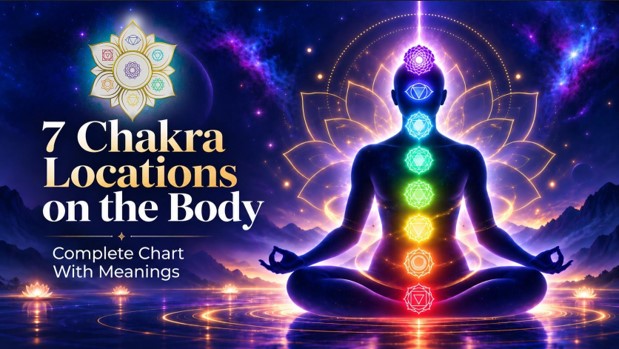
The good thing is, chakras are easy to understand. There are only seven, and they go in a line from the bottom of your back up to your head.
There are just seven main chakras, and they line up in a row—from the base of your spine all the way to the top of your head.
What are Chakras?
“Chakra” comes from Sanskrit and means “wheel.” In yoga traditions, people think of chakras as spinning spots of energy inside the body. In yoga and Ayurveda, these energy circles are pictured as stacked along your spine.
Each chakra spot is linked to a part of your body, a feeling, and parts of life such as feeling safe, being creative, or saying what you think.
Chakras are part of a spiritual tradition. Some people use them to help with meditation or learning about themselves, but chakras aren’t medical facts and can’t tell you what’s wrong with your health.
Chakra Locations Chart
Here’s a quick overview for you. Use this chart as an easy reference, and then check out the detailed sections below for more information.
If you want to see where each chakra is located, try pairing this table with a body illustration that shows the colored centers along the spine.
| | Chakra | Sanskrit Name | Body Location | Color |
| 1 | Root Chakra | Muladhara | Base of the spine | Red |
| 2 | Sacral Chakra | Svadhisthana | Below the navel | Orange |
| 3 | Solar Plexus Chakra | Manipura | Upper abdomen, above the navel | Yellow |
| 4 | Heart Chakra | Anahata | Center of the chest | Green |
| 5 | Throat Chakra | Vishuddha | Throat | Blue |
| 6 | Third Eye Chakra | Ajna | Forehead, between the eyebrows | Indigo |
| 7 | Crown Chakra | Sahasrara | Top of the head | Violet or white |
The order matters, the reason being that traditionally, you begin at the base of your spine and move upward, beginning with practical, physical needs and ending with the most spiritual prospects.
The 7 Chakras, Simply Explained
Root Chakra (Muladhara)
This one is considered to be the lowest one. This is right at the base of your spine, near your tailbone, and it looks to be red.
It’s about feeling safe, stable, and connected to the ground beneath you. When life feels unstable, or you are dealing with big changes, this is how the power of chakras may help in daily life.
You don’t need anything special to connect with it. Stand barefoot for a few minutes or go for a walk. Notice how your feet feel with each step.
Sacral Chakra (Svadhisthana)
The sacral chakra sits just below your belly button. It’s orange and is linked to creativity, fun, and feelings.
If things feel dull or you’re struggling to find joy, this is the chakra to focus on.
Hip-opening stretches, like butterfly pose, are ideal for encouraging flow, creativity, and sensual expression.
They are an easy way to unwind and shake off stress after a long day at your desk, no matter what you believe about chakras.
Solar Plexus Chakra (Manipura)
Move up to the soft spot under your ribs located above your navel. That’s the solar plexus chakra, colored yellow. A solar plexus chakra candle is an easy way to add some calm to your meditation or relaxation routine.
It’s all about confidence and willpower. Its name means “city of jewels.” If you second-guess yourself a lot or have trouble making decisions, tradition points to this chakra.
Boat pose is the best pose to engage your core and focus here. Some people also add a few quick, powerful breaths.
Heart Chakra (Anahata)
This is positioned at the right centre of your chest where it shines green. This basically connects the three lower chakras.
This type of chakra deals with love and affection. Its name is Anahata, and it is traditionally associated with love, forgiveness, and sharing.
Throat Chakra (Vishuddha)
This is at your throat, and the color is blue. A throat chakra candle can be an easy addition to your meditation or relaxation routine.
This chakra is all about being honest and expressing yourself. If you find yourself staying quiet or stressing over what to say, your throat chakra could probably use a little extra care.
Using your voice may help; try humming, singing, or simply speaking up. Even singing alone in the car can make a difference.
Third Eye Chakra (Ajna)
Right between your eyebrows on your forehead is the third eye chakra, colored indigo. It’s about intuition and clear thinking.
If your mind feels muddy or you can’t trust your gut, tradition says to spend time here. Just close your eyes, pay attention to that spot, and sit quietly for a minute or two.
Crown Chakra (Sahasrara)
The crown chakra is on top of your head. Helps you feel connected to something bigger than you.
If you’re searching for meaning or things feel empty, this is the traditional focus. Long, quiet meditation and self-ritual work best here. No expectations—just sit and see what comes.
Why do Chakra Locations Matter?
When someone says “focus on your throat chakra,” it helps to know right where that is. When your mind starts to drift, having a clear map gives you something to focus on. It also makes it easier to follow and understand yoga sequences.
For example, heart-chakra classes usually have backbends and stretches for the chest. Knowing where the chakras are can help yoga classes and routines make more sense.
It can also make it easier to put together your own short yoga or meditation routine at home.
A lot of people use chakras as an easy way to tune in to their body, thoughts, and feelings. Taking a few quiet moments to focus on them can help you get a better sense of how you’re really feeling inside.
You don’t need to believe every part of the tradition; a skeptic can still use the chart as a body scan. Start at the base and work upward, checking in at each spot.
People sometimes focus on their chakras during yoga, meditation, or breathing exercises. It’s an easy way to pause, relax, and check in with how you’re feeling.
Chakras come from a spiritual tradition, so their benefits are based on those beliefs, not on medical science.
Simple things like yoga, meditation, or just taking a few slow breaths can help you unwind and get in touch with how you’re really feeling.
How to Balance Your Chakras
Entire books are written about this, but these four practices show up everywhere:
- Meditation: Find a comfy spot to sit and pick one chakra to focus on. Begin with the lowest one. Take a few slow breaths, then move up to the next, all the way to the top.
- Yoga poses: To balance your chakras, do yoga poses that go with each one. Do Mountain Pose for your root chakra, butterfly poses for your sacral chakra, and core moves for your solar plexus.
- Breathwork: Slow breathing helps you focus. Alternate nostril breathing (nadi shodhana) is commonly used before chakra meditation.
- Color visualization: Picture each chakra as a little wheel of light in its own color. As you breathe, see that light getting brighter and clearer. If you like, you can add candles or stones in those colors.
Frequently Asked Questions
Where are the 7 chakras?
They are lined up in your body, starting at the base of your spine and ending at the top of your head.
What’s the order from bottom to top?
The chakras go in this order: root, sacral, solar plexus, heart, throat, third eye, and crown, starting with basic needs at the bottom and moving up to self-expression.
What color is each chakra?
They match the rainbow: red, orange, yellow, green, blue, indigo, and violet at the top.
What if a chakra gets blocked?
When a chakra is blocked, the energy there isn’t moving well. This can make you feel off-balance or stuck. It’s a spiritual concept.
How do I know which chakra is out of balance?
Notice patterns, feeling insecure, trouble speaking up, or tightness in one spot. Those are traditional hints.
What’s the difference between root and crown chakras?
They’re at opposite ends and work together. The root keeps you grounded; the crown opens you to something bigger.
From Root to Crown: Your Chakra Map in a Nutshell
Seven spots, one line, from the base of your spine to the top of your head—that’s the map. Once you know where each one is, yoga and meditation make more sense.
Lots of people use it just to check in with themselves, bottom to top, to see how they’re really doing. A few quiet minutes can help you settle and reconnect with your body.
Chakra practice is gentle and supportive.
This practice enhances and relaxes the body and the surrounding nerves, creating a soothing experience. Further, it captures the essence of how chakras work, improving the manifestation of core beliefs.
Let chakra work be a comfort alongside real help, not a substitute. Ready to explore your chakras? Reach out to Chakra Spot and take a closer look at what each one represents.